
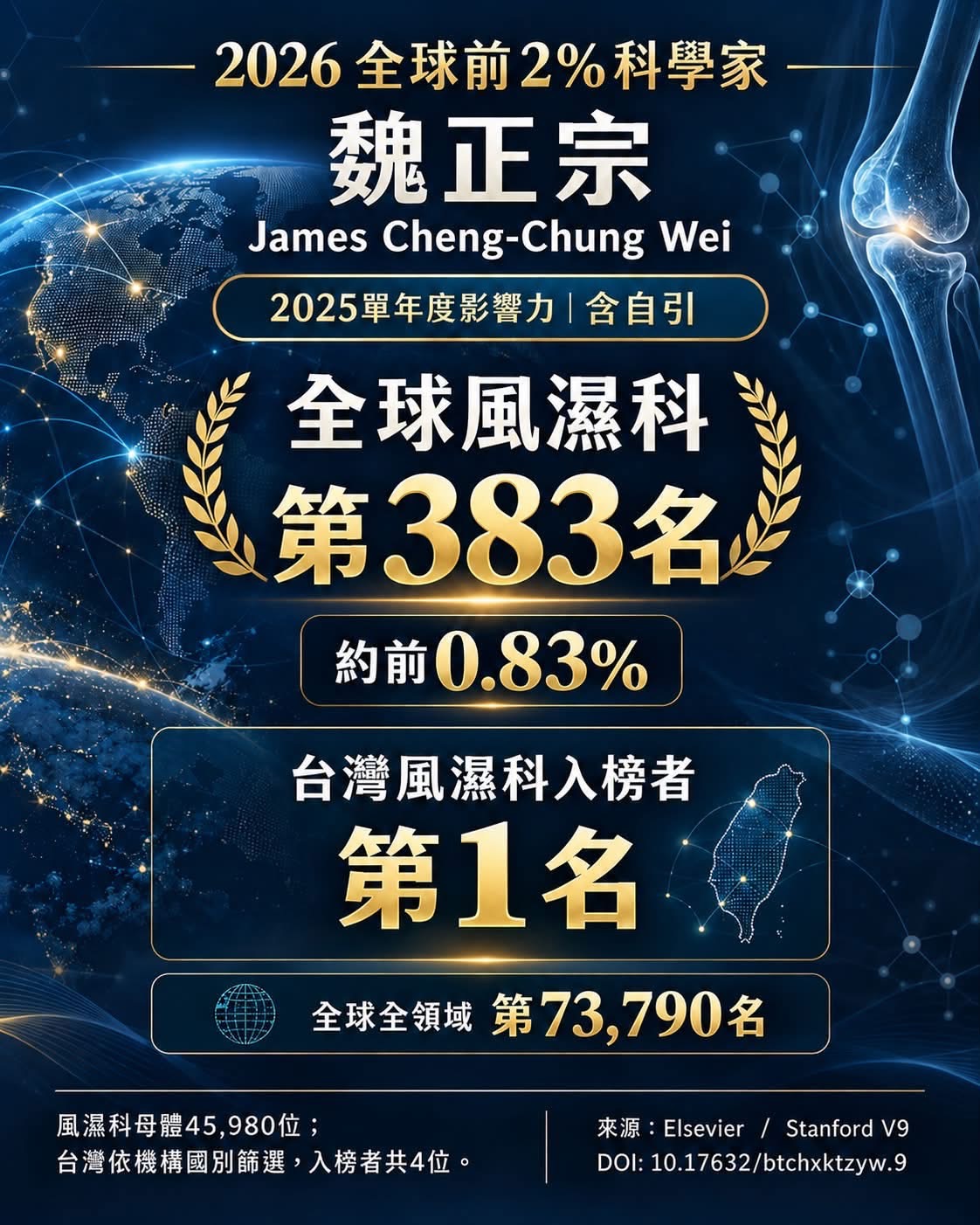
2026 listing | 2025 single-year impact, including self-citations
- Rheumatology worldwide
- 383 · approximately top 0.83%
- Listed rheumatology researchers in Taiwan
- 1 · filtered by institutional country
- Worldwide, All Fields
- 73,700 · single-year impact
- Rheumatology Reference Population
- 45,980researchers
Taiwan rankings are filtered by institutional country; 4 rheumatology researchers appear in the list. All figures use single-year impact including self-citations.
Celebrating the President’s International Academic Recognition
According to the recognition poster supplied by the Society, President Professor James Cheng-Chung Wei was named in the 2026 World’s Top 2% Scientists listing. Based on 2025 single-year impact including self-citations, he ranked 383rd worldwide in rheumatology, approximately the top 0.83% in that field, and 73,700th worldwide across all fields.
Filtering listed rheumatology researchers by the country of their affiliated institution identifies 4 researchers in Taiwan, with President Wei ranked 1st. The Society and its members congratulate him and continue advancing medical big data research and academic exchange, starting from clinical questions.
The 2026 Listing Reflects 2025 Single-Year Impact
The source is version 9 of the Elsevier/Stanford “Updated science-wide author databases of standardized citation indicators,” published on October 7, 2026, using a Scopus data snapshot from August 1, 2026. The single-year data count citations received during 2025.
This announcement uses single-year impact figures including self-citations. The database also provides career-long impact and metrics excluding self-citations; rankings should be compared using the same definitions. The approximate top 0.83% is calculated from rank 383 among 45,980 rheumatology researchers. The Taiwan ranking filters listed researchers by their institution’s country.
Full Recognition Poster
View Elsevier Database, Version 9
Ranking figures and the poster were supplied by the Society. Publication date and reporting year follow the description of Elsevier database version 9. DOI: 10.17632/btchxktzyw.9.
Back to All News